
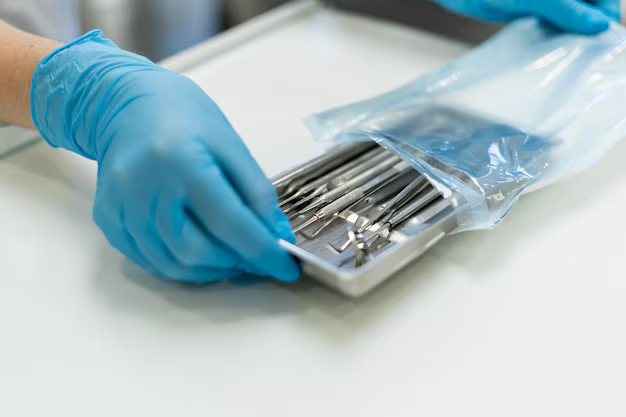
Across industries, the gap between a product’s potential and its realized value often exists in the packaging. Specialized packaging is important because the modern world is in an era of “High-Value Fragility.” As products become smaller and sophisticated, from luxury personal items and sensitive electronics, to medical devices, they also become highly vulnerable to degradation and damages. Thus, treating packaging of such items as a technical discipline rather than an afterthought is the difference between functional delivery and catastrophic dead-on-arrival (DOA) costs.
- Cushioning Theory: Engineering Protection against Invisible Threats
The core of high-sensitivity packaging lies in precision shock absorption of quality protective foam inserts, with a design that understands that high-sensitivity packaging is not about “padding,” but about the controlled management of kinetic energy. Experts apply principles from cushioning theory to real-world transport and handling.
- G-factor design: Foam density and structure are tailored so delicate items survive sudden impacts, drops, or compression.
- Static load resistance: Prevents “bottoming out” under heavy stacks or transit stress.
- Frequency isolation: Each insert is tuned to the product’s resonance, reducing micro-vibration damage in sensitive electronics, optics, or industrial instruments.
This is where design transforms into risk management: a medical laser, a $50k camera lens, or a prototype can endure multiple handling points without loss of calibration or alignment. Packaging becomes a controlled environment that shields value rather than simply containing it.
- Material Science: Defying Chemistry and Electricity
Material choices are the difference between protection and catastrophe. It is essentially the scientific foundation of the high-sensitivity System. Every protection detail matters: low quality off-gassing foam, packaging that generates static electricity—too small for a human to feel—can “fry” the microscopic circuits of a flight computer, and you lose more than money—you risk life and lose credibility.
- Anti-Static (ESD) foam: Controls dissipation of electricity that can cause latent failure of electronics or optical sensors; through electrical pathing. The risk is that dissipation doesn’t “kill” components instantly.
- Closed-cell polyethylene: It is the Physical Fortress” of the system. Blocks moisture, oils, chemicals—even Skydrol—and ensures the packaging stays structurally sound in brutal conditions.
- Tailored densities: Absorb shocks without crushing the item, balancing human ergonomics and engineering precision.
Radical reality: businesses are shipping not just products but high-stakes investments. A packaging failure is no longer minor, it’s a visible product care parameter and a costly betrayal of trust.
- Precision Fabrication: Where Technology Meets Discipline
The right material means nothing without exact execution.
- Waterjet cutting: Zero-heat, stress-free cavities for heavy or complex shapes.
- Laser cutting: Smooth edges, intricate details, branding that tells the world this item is worth protecting.
- CNC routing: Eliminates lateral migration, stopping abrasion before it begins.
- Push-point ergonomics: Reduces handling strain while protecting foam and item.
This isn’t packaging—it’s industrial choreography. Every cut, contour, and cavity transforms the package into a high-precision platform: secure, presentable, and radically trustable, signaling to investors, clients, and teams that you safeguard value before it leaves your hands.
- Operational and Financial Impact: Protection as Profit
High-sensitivity packaging isn’t a cost—it’s capital armor.
- Damage reduction: This refers to the direct recovery of lost capital. In many high-tech or luxury industries, a “Standard” packaging approach (bubble wrap, generic boxes) results in a failure rate of roughly 7%. That is against 1% standard when using tailored foam densities and anti-static materials.
- Labor efficiency: Organized inserts free staff to focus on revenue-driving work, not searching or repairing. With shadow boards and bespoke cases, there is zero search time. That addresses the Opportunity Cost of your workforce.
- Inventory control: Clear homes prevent duplicate purchases, accelerating turnover.
- Brand reinforcement: Clients see precision, professionalism, and care with every delivery.
Radical perspective: in museums, luxury goods, or industrial tech, a single mishandled item can destroy months of trust and millions in value. Investing in technical packaging is an insurance policy, a competitive differentiator, and a silent statement: “We respect the value we move.”
In essence, the collective advantage of specialized packaging for sensitive and fragile items and tools is resilience. In a world where supply chains are fragile and labor is expensive, bespoke packaging solutions provide the leverage to:
Elevate how you are perceived.
Protect what you have.
Optimize how you work.
Stay in touch to get more updates & news on Touch Cric!